Livre Épuisé.
Exemplaire avec marques d’étagère sur la tranche de queue. Intérieur état Neuf.
En 1878, Photographic Times affirmait que dix minutes constituaient un temps de pose suffisant pour photographier un paysage. Six ans plus tôt, un immigrant anglais installé sur la côte Ouest, Eadweard Muybridge, connu sous le nom commercial de Helios, avait déjà poussé la photographie dans la direction exactement opposée : non pas accumuler le temps dans l’image, mais au contraire le fractionner grâce aux expositions les plus rapides alors imaginables. En 1872, le magnat Leland Stanford avait chargé Muybridge de photographier son cheval, Occident, afin de déterminer s’il soulevait à un moment donné ses quatre sabots simultanément. En démontrant que tel était bien le cas, Muybridge réalisa une exposition d’un cinq-centième de seconde et inaugura ainsi une anatomie du mouvement — chez l’homme, le cheval, les oiseaux — qui bouleversa les possibilités de la photographie et conduisit, à terme, à l’invention du cinéma.
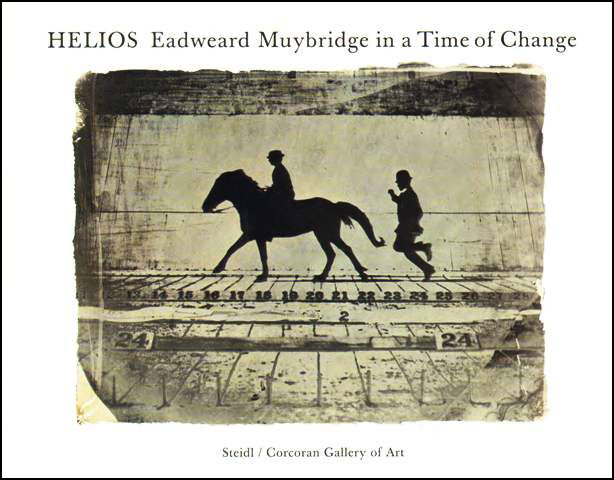
Helios: Eadweard Muybridge in a Time of Change offre l’occasion de retracer la vie et l’œuvre de ce grand photographe. Dans le sillage de récentes recherches et d’un regain d’intérêt pour son travail, l’ouvrage confronte l’ensemble de sa production à l’arrière-plan de l’une des périodes les plus profondément transformatrices de l’histoire américaine et européenne. Publié à l’occasion d’une exposition rétrospective organisée par la Corcoran Gallery of Art, Helios réunit des essais de Philip Brookman, Marta Braun, Corey Keller et Rebecca Solnit, qui proposent de nouvelles approches de l’art et des influences de Muybridge. Né en Angleterre, Eadweard J. Muybridge (1830–1904) émigra aux États-Unis au début de la vingtaine, où il travailla comme libraire pendant près de dix ans. À la suite d’un accident de diligence, il apprit la photographie durant sa convalescence en Angleterre. De retour à San Francisco en 1867, sous le nom de Helios, il entama le travail qui devait assurer sa renommée ; sous la direction de Philip Brookman, photos en n.b.
Out of Print Book.
Copy with marks on the slice tail. Inside as New.
In 1878, the Photographic Times claimed that ten minutes provided sufficient exposure for photographing a landscape. Six years earlier, an English immigrant to the West Coast named Eadweard Muybridge, going by the commercial name of Helios, had already pushed photography far in the opposite direction: not to soak up time into pictures, but to divide time with the quickest exposures then imaginable. In 1872, the tycoon Leland Stanford had commissioned Muybridge to photograph his horse, Occident, to determine whether it ever lifted all four hooves off the ground at once. In proving that this was indeed the case, Muybridge achieved a five-hundredth-of-a-second exposure, and so began an anatomy of motion-in humans, horses, birds-that exploded the possibilities of photography and ultimately led to the development of the motion picture.
Helios: Eadweard Muybridge in a Time of Change offers an opportunity to trace the life and art of the great photographer. In the wake of a wave of recent scholarship and renewed interest, it pitches his entire body of work against the backdrop of one of the most transformative periods of American and European history. Published to accompany a retrospective exhibition organized by the Corcoran Gallery of Art, Helios features essays by Philip Brookman, Marta Braun, Corey Keller and Rebecca Solnit that provide a variety of new approaches to Muybridge’s art and influences. Born in England, Eadweard J. Muybridge (1830-1904) moved to the United States in his early twenties, working as a bookseller for nearly ten years, until, after a stagecoach accident, he learned photography while convalescing in England. Returning to San Francisco in 1867, operating under the name of Helios, he commenced the work that was to secure his fame ; edited by Philip Brookman.